
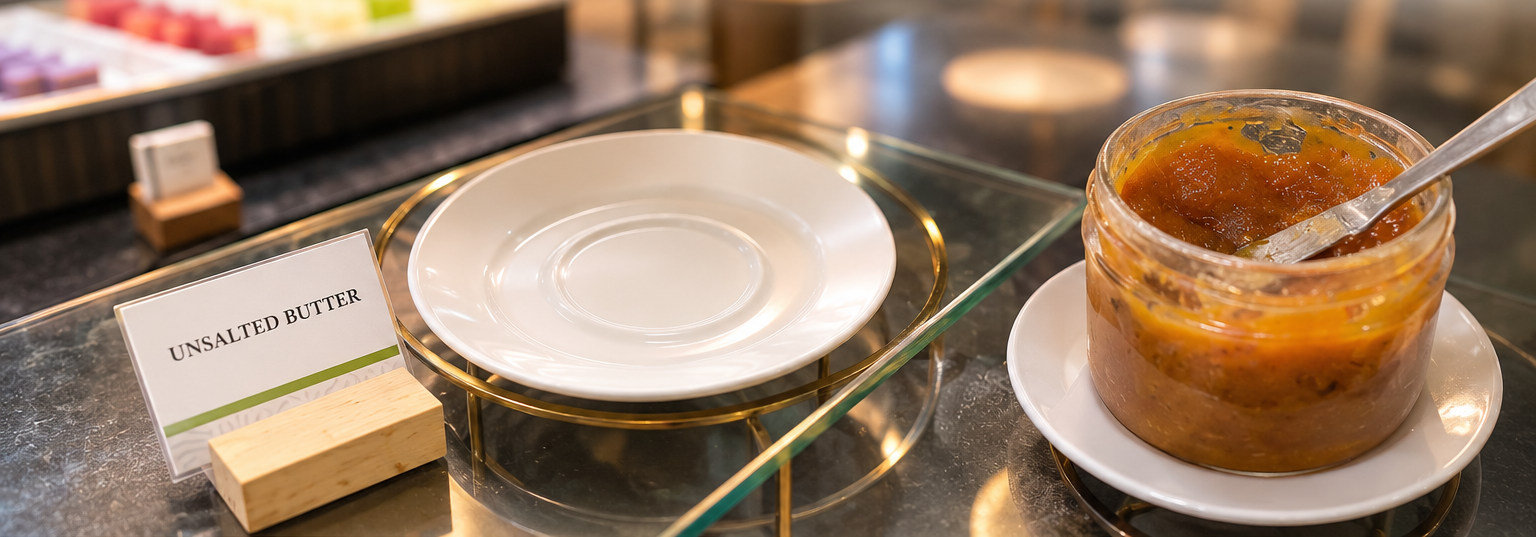
Breakfast should be one of the simplest experiences a hotel delivers. Guests arrive, choose what they would like to eat, enjoy their meal and continue with their day.
But what happens when even the most basic breakfast requirements cannot be met?
And, more importantly, what happens when the hotel knows a Guest has left without eating, yet nobody thinks to do anything about it?
Sometimes the greatest failures in hospitality are not the things that go wrong.
They are the opportunities to put them right that nobody recognises.
A Guest who wanted very little
In a hotel recently visited, a Guest had a remarkably simple breakfast routine.
Some fresh fruit, yoghurt and a piece of toast.
Nothing elaborate. No special dietary preparation. No complicated requests.
Usually, a chef would thoughtfully bring over a selection of fruit and yoghurt. It was a small gesture, but one that demonstrated recognition, personalisation and care.
On this particular morning, that gesture never happened.
The Guest went to the buffet instead.
There was no melon. No yoghurt. Not even butter for the toast.
Plates were unavailable, coffee was cold and replenishment appeared to have fallen significantly behind demand.
After 30 minutes, the Guest gave up.
No breakfast. No alternative.
Just the decision to leave.
The Guest Relations Manager knew. So what happened next?
Before leaving, the Guest spoke to the Guest Relations Manager, who subsequently followed the Guest out of the restaurant.
The situation was therefore not an undiscovered service failure.
The hotel knew.
The Guest then contacted both the Guest Relations Manager and hotel management to explain what had happened.
Management responded with an apology. The Guest Relations Manager did not respond to the message.
The Guest then had to contact management again, explaining that their response was unacceptable and lacked any genuine hospitality.
And that appeared to be the end of the matter.
But something fundamental had been missed.
The Guest had still not eaten breakfast.
Nobody proactively contacted the Guest to ask whether they would like breakfast in the lobby lounge.
Nobody offered to arrange fruit, yoghurt and toast in the room.
Nobody suggested an alternative or took the initiative to ensure that the Guest had actually eaten.
The operational complaint had been acknowledged.
The Guest’s needs had not.
An apology does not resolve a Guest’s need
This is where the difference between Guest service and genuine hospitality becomes particularly apparent.
A service-focused response might be:
“We are very sorry about your experience this morning. We will share your feedback with the team.”
It is polite. It acknowledges dissatisfaction. It may even lead to an internal discussion.
But what has it actually achieved for the Guest?
Nothing.
The Guest is still hungry.
A hospitality-focused response would have recognised the immediate, unresolved need.
“I am terribly sorry that breakfast was such a disappointment. I realise you haven’t had anything to eat. May I arrange some fresh fruit, yoghurt and toast for you in the lounge or have it delivered to your room?”
One response closes a complaint.
The other begins to recover an experience.
And the difference is enormous.
The Guest should not have to design the solution
One of the most disappointing aspects of service recovery is when hotels unintentionally place responsibility for finding a solution back onto the Guest.
The Guest has already experienced the problem.
The Guest has already explained what happened.
Why should the Guest now have to suggest how the hotel might put it right?
Recognising the need, proposing a practical solution and taking ownership of its delivery should be instinctive hospitality behaviours.
They should not depend on the Guest asking the right questions or escalating a complaint to increasingly senior members of management.
In this case, the solution was hardly complicated.
A small plate of fruit. A yoghurt. Some toast.
Yet the Guest was left contemplating whether the only way to get breakfast was to visit McDonald’s.
Think about that for a moment.
A Guest staying in a hotel that serves breakfast was left wondering where else they could find something to eat.
Not because the hotel had no food, but because the buffet was not being replenished.
And because nobody offered to arrange any.
When operational pressure exposes a deeper weakness
Hotels get busy. Occupancy fluctuates. Staffing can be challenging. Casual labour may be necessary, and replenishment sometimes falls behind demand.
These are operational realities.
But they cannot become an excuse for abandoning the fundamentals of hospitality.
When a property delivers excellent service during quieter periods but repeatedly struggles under pressure, management should question whether its staffing, skills, supervision and service expectations are properly aligned.
The Guest does not see the staffing roster.
The Guest does not know how many casual team members have been deployed.
The Guest does not know which department was responsible for replenishing the buffet.
Nor should they need to.
They simply experience the outcome.
And when the outcome is poor, they expect someone to care enough to put it right.
Indeed, when an operation is under pressure, recognising individual Guest needs becomes even more important.
That is precisely when genuine hospitality must be most visible.
The questions management should be asking
This incident should prompt a discussion that goes well beyond breakfast replenishment.
If a Guest leaves a restaurant without eating, who takes ownership?
Does the Guest Relations Manager see a Guest walking away as the conclusion of a complaint, or the beginning of a service recovery opportunity?
Are managers trained to identify the underlying Guest need rather than simply respond to the expressed dissatisfaction?
Is there a process to ensure that a Guest’s immediate needs have been addressed before an incident is considered resolved?
And perhaps most importantly, does the team understand the difference between completing a service task and caring for a Guest?
These are not questions that can be answered by checking whether butter has been replenished or whether additional plates have been delivered.
They are questions about culture, leadership, emotional intelligence and the very meaning of hospitality.
The GUESTX View
The initial failure was operational.
The buffet was inadequately replenished, and a Guest was unable to have breakfast.
That should never have happened.
But the more significant failure came afterwards.
The hotel knew what had happened. Management had been informed. There was an opportunity to demonstrate genuine care, take ownership and turn a disappointing morning into a positive example of service recovery.
That opportunity was missed.
A sincere apology matters, but it is not a substitute for action.
Great hospitality is not simply about remembering a Guest’s preferences when everything is running smoothly. It is about remembering the person when something goes wrong.
The most meaningful service recovery often requires little money, no elaborate compensation and no exceptional authority.
It simply requires someone to recognise what the Guest needs and care enough to act.
The Guest did not need another apology.
The Guest needed breakfast.
And therein lies the difference between delivering a service and delivering genuine hospitality.
← Back to blog